Asking for a Review Without Sounding Desperate
By Julia Morgan · Published 2026-10-28 · Updated 2026-10-09
Online reviews matter to almost every business that sells to the public, and many businesses feel that pressure acutely. The temptation is to ask often and urgently, to explain how much each review helps a small team, or to offer a discount in exchange for five stars. Each of these tends to backfire. Customers notice when a request sounds needy, and several of the common shortcuts are now prohibited by the review platforms themselves.
Two practices in particular deserve plain warnings. The first is review gating, where a business asks customers how they feel first and then only sends the happy ones to a public review site; Google's review policies, among others, prohibit selectively soliciting positive reviews. The second is incentivised reviews, where a reward is offered for leaving a review, and especially for a positive one. In the United States, the Federal Trade Commission's rule on consumer reviews, announced in 2024, specifically targets incentives conditioned on the sentiment of a review, and platform policies go further in several cases.
The good news is that an honest, well-timed request works well on its own. Most customers who had a good experience are genuinely willing to leave a review if someone asks clearly and makes it easy. This guide covers when to ask, how to word the request, sample emails, the rules on incentives and gating, and how to handle reviews once they arrive.
Quick Answer: Ask for a review shortly after a positive experience, with one short, friendly email that links directly to the review page and asks everyone, not just customers you expect to be happy. Do not offer rewards for reviews, never filter out unhappy customers first, and follow up once at most.
Why Review Requests Sound Desperate
Review requests genuinely sound desperate when they lean on the sender's needs, repeat themselves or offer something in return for praise.
Making It About Your Business
Explaining how much reviews help a small team, or how few reviews you have, shifts the focus to the business's problem. Customers may sympathise, but it genuinely makes the request feel like an obligation rather than an invitation to share an honest view.
Asking Too Often
Several reminders about a review, or asking after every small interaction, quickly becomes noticeable. Customers who feel chased are genuinely less likely to leave a review, and some may leave a less generous one than they would have written if asked once.
Pushing for a Particular Rating
Wording such as 'if you had a five-star experience' or 'we would love a 5-star review' tells the customer what to write. It genuinely undermines the credibility of the reviews you receive and may conflict with platform rules on influencing ratings.
The Rules on Incentives and Review Gating
Offering rewards for reviews and filtering out unhappy customers before they reach a review site are genuinely prohibited or restricted by major platforms and, in some places, by law.
What Review Gating Is and Why It Is Out
Review gating means asking customers for private feedback first and then inviting only satisfied ones to post publicly. Google's policies prohibit selectively soliciting positive reviews, and other platforms have similar rules, so the honest approach is genuinely to ask everyone the same way and let the reviews reflect real experience.
Incentives for Reviews
Offering discounts, entries or gifts in exchange for reviews is prohibited on Google and several other platforms, whether or not the review is positive. In the United States, the FTC's consumer review rule targets incentives conditioned on positive or negative sentiment, and it is genuinely safest to offer no reward for reviews at all.
Check the Rules That Apply to You
Platform policies change and differ from one another, and consumer protection rules vary by country. Before running any review campaign, it is genuinely worth reading the current policy of the platform you are directing people to, rather than relying on a summary that may be out of date.
When to Ask for a Review
The best time to ask is genuinely soon after the customer has experienced the result, while the details are fresh and before the moment passes.
Shortly After Delivery or Completion
For products, that may be a few days after delivery once the customer has used the item; for services, shortly after the work is complete. Asking too early, before the customer has had a chance to judge the result, genuinely produces fewer and less detailed reviews.
After a Problem Was Resolved Well
Customers whose issue was resolved quickly and kindly often feel strongly positive about the business. Asking them, in the same way as everyone else, is genuinely reasonable, provided the request comes after the resolution rather than as part of it.
Not During Ongoing Work
Asking mid-project or while an order is still in progress puts customers in an awkward position. It is genuinely better to wait until there is something complete to review, which also makes the review itself more useful to future readers.
How to Write a Review Request
A good review request is genuinely short, polite, links straight to the review page and leaves the customer free to write whatever they think.
Keep It to a Few Lines
Thank the customer, ask whether they would be willing to share their experience, and include the link. Anything longer genuinely increases the chance the customer postpones it, and postponed review requests are rarely completed.
Link Directly to the Review Form
A link that opens the review form, rather than your profile page, removes several steps. Every extra click genuinely loses some customers, particularly on mobile, where most review requests are read.
Ask for Honesty Explicitly
A line such as 'whatever your experience, we would value an honest review' signals that you are not fishing for praise. It genuinely makes the request feel more trustworthy and fits both platform rules and the spirit of reviews.
Sample Review Request Emails
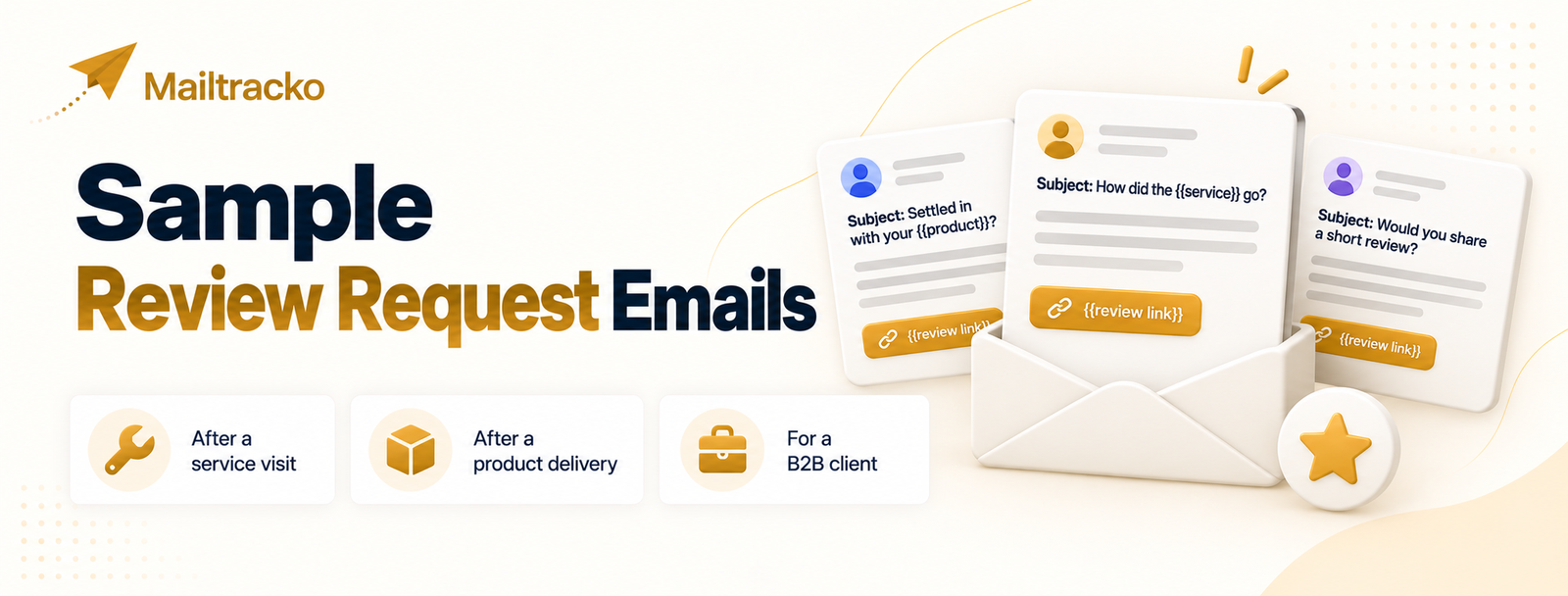
These templates genuinely work best when the placeholder details are filled with something specific to each customer's experience.
After a Service Visit
Subject: How did the {{service}} go?
Hi {{First Name}},
Thanks for choosing us for {{service}} on {{date}}. If you have a minute, we would value an honest review of your experience; it helps other people decide whether we are right for them.
{{review link}}
Thank you,
{{Sender Name}}
After a Product Delivery
Subject: Settled in with your {{product}}?
Hi {{First Name}},
Your {{product}} arrived a few days ago, so we hope you have had a chance to try it. Whatever you think of it, an honest review would be really useful to other customers.
{{review link}}
{{Sender Name}}
For a B2B Client
Subject: Would you share a short review?
Hi {{First Name}},
Now that {{project}} is complete, would you be willing to write a short, honest review on {{platform}}? Two or three sentences about what it was like working with us would be plenty.
{{review link}}
Thanks either way,
{{Sender Name}}
Handling Reviews Once They Arrive
How you respond to reviews genuinely matters as much as how many you collect, especially when a review is critical.
Reply to Critical Reviews Calmly
A short, polite response acknowledging the issue and offering to resolve it privately shows future customers how you treat people when things go wrong. Arguing publicly genuinely does more damage than the original review, however unfair it may feel.
Thank Positive Reviewers Briefly
A brief thank-you under a positive review is courteous, but it does not need to be long. Generic identical responses on every review can look automated, so it is genuinely better to write a short personal line or none at all.
Use Reviews as Feedback
Patterns across reviews, such as repeated comments about delivery times, are genuinely useful operational feedback. Treating them as information rather than only as marketing assets makes future reviews better for the right reasons.
Sending Review Requests With a Mail Merge
Review requests can reasonably be sent with a mail merge, provided every customer is genuinely asked the same way and the timing follows each customer's experience.
Build the List From Completed Orders or Jobs
A merge sheet drawn from completed orders or finished jobs, with columns such as {{First Name}}, {{service}} and {{date}}, lets each request reference the specific experience. Filtering by completion date genuinely keeps the timing close to the moment the customer formed a view.
Do Not Filter by Satisfaction
It can be tempting to remove customers who raised complaints from the review list, but that is a form of selective solicitation. The honest and policy-compliant approach is genuinely to ask every eligible customer in the same way, while handling any open complaint through support first.
Keep Batches Small and Replies Monitored
Sending in small batches from a Gmail-based tool such as MailTracko means replies can be answered promptly. Some customers reply with feedback rather than posting a review, and those messages genuinely deserve a personal response, whatever they say.