Catch-All Domains What They Are and How to Handle Them
By Julia Morgan · Published 2026-10-25 · Updated 2026-10-26

A catch-all domain accepts mail addressed to anything at that domain, whether the mailbox exists or not. Send to a genuine colleague and it arrives; send to a name invented at random and the server accepts that too. From the outside the two are indistinguishable, which is precisely the problem for anyone trying to verify a list.
Organisations configure this for reasonable reasons. It prevents mail being lost to typos, catches messages to former staff, and supports departmental addresses without maintaining each one. For the recipient it is a convenience; for a sender it removes the only mechanism that would confirm an address is real before sending to it.
Verification services therefore return these addresses as unknown rather than valid or invalid, which leaves the sender with a decision. This guide covers how catch-alls work, why they cannot be verified, the risks they carry, how to handle them in practice, and what they mean for list quality overall.
Quick Answer: A catch-all domain accepts mail to every address, which means verification cannot confirm whether a specific mailbox exists and returns the result as unknown. The risk is that invalid addresses do not bounce, so they never get cleaned, and some become spam traps. Handle them as a separate segment rather than discarding or trusting them.
How Catch-Alls Work

A catch-all server genuinely accepts every address at the domain and sorts out the destination afterwards.
Acceptance Happens Before Validation
The receiving server accepts the message during the connection and only afterwards decides where it goes, which genuinely means the sender receives a success response regardless of whether a mailbox exists. Any subsequent failure is invisible to the sender because the acceptance has already been confirmed.
Why Organisations Use Them
Preventing lost mail from misspelled addresses, continuing to receive messages for staff who have left and supporting varied departmental addresses genuinely all justify the configuration from the recipient's perspective. It is particularly common among smaller businesses and those using certain hosting arrangements by default.
What Happens to the Mail
Messages to non-existent addresses genuinely land in a general mailbox, a folder nobody reads, or occasionally are discarded silently after acceptance. The sender has no way to distinguish between these outcomes, and in the last case the message has effectively vanished while appearing delivered.
Why Verification Cannot Confirm Them
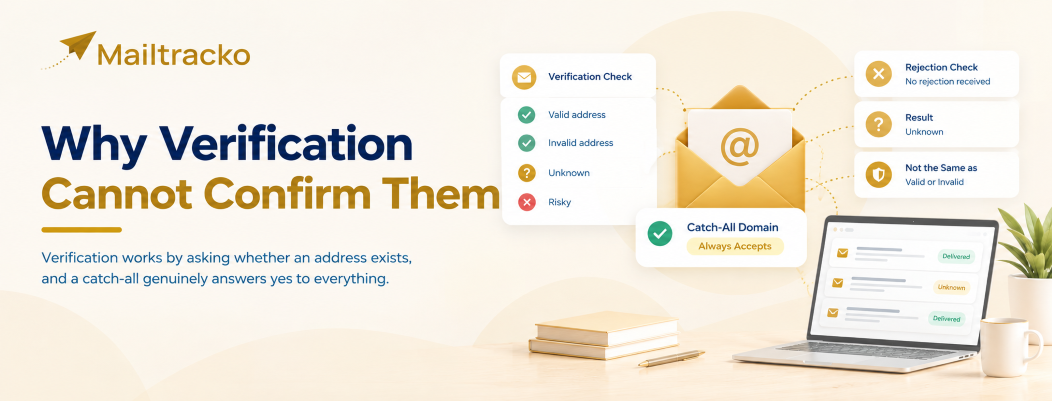
Verification works by asking whether an address exists, and a catch-all genuinely answers yes to everything.
The Check Relies on Rejection
Address verification determines validity by observing whether a server would reject the recipient, and a catch-all genuinely never does. The check therefore returns no useful information, which services report as unknown, accept-all or risky depending on their terminology.
Unknown Is Not the Same as Invalid
An unknown result genuinely means the address could not be checked rather than that it is bad, and a substantial proportion of catch-all addresses are perfectly valid working mailboxes. Treating the entire category as invalid discards real prospects, which is the overcorrection some senders make.
Nor Is It the Same as Valid
Equally, an address at a catch-all domain that was guessed from a name pattern genuinely may not exist, and sending to it produces no bounce to reveal that. Treating unknown as acceptable means invalid addresses accumulate in the list permanently, which is the other overcorrection.
The Risks They Carry

Catch-alls genuinely allow invalid addresses to persist invisibly, which produces problems that no metric reveals.
Bad Addresses Never Bounce Out
The normal mechanism by which a list cleans itself is bounces, and catch-all addresses genuinely never produce one regardless of whether the mailbox exists. A list heavy with them looks healthier than it is, because the bounce rate no longer reflects the proportion of dead addresses.
Some Become Traps
Domains that were once active and are now maintained as catch-alls genuinely can be repurposed, and addresses at them may function as traps. This is a minority case and it is the reason unknown addresses are described as risky rather than merely unverifiable.
Guessed Addresses Are the Real Danger
Addresses constructed from a name pattern rather than obtained from the person genuinely carry most of the risk, and catch-alls remove the feedback that would reveal the guesses as wrong. A list built by pattern-guessing against catch-all domains is accumulating errors it cannot detect.
Handling Them in Practice
Catch-alls genuinely warrant a separate segment rather than inclusion or exclusion.
Segment Rather Than Delete
Keeping unknown addresses in their own segment genuinely allows them to be sent to deliberately, in smaller volumes, while keeping them out of the main list. This preserves the valid ones without letting them distort the quality of the rest.
Send to Them Separately
Sending to the catch-all segment as its own campaign genuinely contains any risk and allows the results to be compared against the verified list. If replies from that segment are comparable, the addresses are largely real; if they are close to zero, the segment is mostly guesses.
Prune Without Bounce Evidence
Because these addresses never bounce, removal genuinely has to be based on engagement rather than on delivery failure. An address at a catch-all domain that has received several campaigns with no response should be treated as dead even though nothing confirms it.
What They Say About List Quality
A high proportion of catch-all addresses genuinely indicates something about how the list was built.
Pattern Guessing Shows Up Here
A list where a large share of addresses are unverifiable genuinely suggests they were constructed rather than collected, because addresses given by their owners are verifiable at the usual rate. This is a useful diagnostic about acquisition method rather than only about the addresses themselves.
Some Sectors Are Simply Catch-All Heavy
Small businesses, certain hosting arrangements and some regions genuinely produce more catch-all domains than others, which means a high proportion is not always evidence of bad practice. Comparing against what is normal for the target market prevents drawing the wrong conclusion.
Ask Rather Than Guess
The alternative to guessing an address at a catch-all domain is genuinely finding the real one — through the company's own site, a directory, a connection or by asking. This is slower and it produces addresses that verify, engage and do not silently fail.
Finding Real Addresses at Catch-All Domains

The alternative to guessing is genuinely finding the actual address, which is usually possible.
The Company Publishes More Than It Realises
Team pages, press releases, job postings, conference listings, published documents and support pages genuinely contain real addresses or the names needed to find them. This is research rather than inference, and it produces addresses that exist rather than addresses that might, which matters enormously at a catch-all domain where nothing will confirm the difference.
Confirm the Format From a Known Address
One verified address at an organisation genuinely reveals the format used for everyone else, which converts a guess into an informed construction. This is considerably more reliable than assuming a common pattern, and a single confirmed example is usually findable.
Ask Through Another Route
A message through a professional network, a mutual contact or even the general enquiries address asking who handles an area genuinely produces the right contact without guessing. This is slower than constructing an address and it produces one that works.
Accept That Some Are Not Reachable
Where no real address can be found, the honest conclusion is genuinely that the prospect is not reachable by email rather than that a guess should be sent. Removing them from the list is better than filling it with constructions that will never bounce and never reply.
Measuring the Catch-All Segment
Separating catch-all addresses genuinely allows their real performance to be measured rather than assumed.
Compare Reply Rates
Sending to the catch-all segment separately and comparing its reply rate against the verified list genuinely answers whether those addresses are real, which no verification service can. A segment replying at a comparable rate contains real people; one replying at near zero is mostly constructions.
Watch for the Absence of Everything
A segment producing no bounces, no replies and no unsubscribes is genuinely a warning rather than a neutral result, because real recipients produce some signal even when they are not interested. Complete silence across a meaningful volume suggests the messages are reaching nobody.
Track It Separately Over Time
Keeping the segment's metrics apart from the main list genuinely prevents it distorting the overall picture, which it otherwise does by adding recipients who never bounce and never engage. This also makes the decision to keep or discard the segment evidence-based.
Prune Aggressively
Because nothing will ever confirm these addresses are dead, genuinely applying a shorter engagement window to them than to the verified list is the appropriate compensation. An unverifiable address with no response after a few campaigns has earned removal.
Catch-Alls and Compliance
Sending to constructed addresses genuinely raises questions beyond whether the mailbox exists.
A Guessed Address Was Not Given to You
An address constructed from a name pattern was genuinely never provided by the person, which matters in jurisdictions where the basis for contacting an individual depends on how their details were obtained. This is a different question from whether the address works, and a catch-all domain removes even the technical feedback that would prompt the sender to consider it.
Corporate Exemptions Have Limits
Where a regime treats business contact more permissively, that treatment genuinely tends to attach conditions about relevance and identification rather than providing open permission. Constructed addresses at business domains sit inside that framework rather than outside it, and the conditions still apply.
You Cannot Honour What You Cannot Track
A person who never received a message because the constructed address does not exist genuinely cannot opt out, and the address stays on the list indefinitely producing nothing. This is a practical problem as well as a compliance one, since the list accumulates entries that can never be resolved either way.
The Safer Practice Is Also the Better One
Using addresses obtained rather than constructed genuinely resolves the compliance question, the deliverability question and the conversion question simultaneously. This alignment is unusual and it is a reasonable argument for the slower approach to list building.