How to Define an Ideal Customer Profile for Outreach
By Julia Morgan · Published 2026-10-27 · Updated 2026-10-09
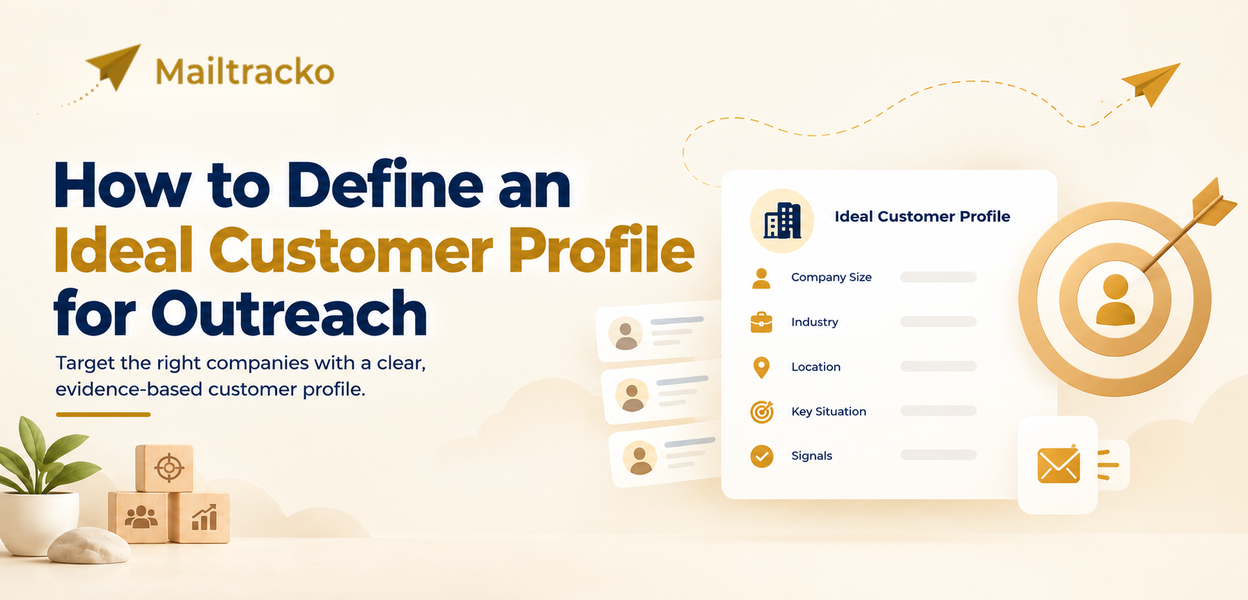
Most outreach problems that look like copywriting problems are actually targeting problems. A well-written message sent to people who do not need what you offer produces nothing, while an adequate message sent to people with the exact problem you solve produces conversations. The ideal customer profile is the decision about who those people are.
Many businesses have an ideal customer profile in name only: a sentence describing small and medium businesses in several sectors that could benefit from the product. That is not a profile; it is a description of most of the economy, and it produces prospect lists too broad to research and messages too general to land.
A useful profile is narrow enough to exclude most businesses and specific enough to guide research. This guide covers what a profile should contain, how to build it from existing customers, how to turn it into a list, how profiles differ from buyer personas and how to keep the profile current.
Quick Answer: A useful ideal customer profile describes the companies most likely to buy and succeed — by size, sector, situation and observable signals — based on your best existing customers rather than assumption. It should be narrow enough to exclude most businesses and concrete enough that a researcher can tell whether a company fits.
What a Useful Profile Contains
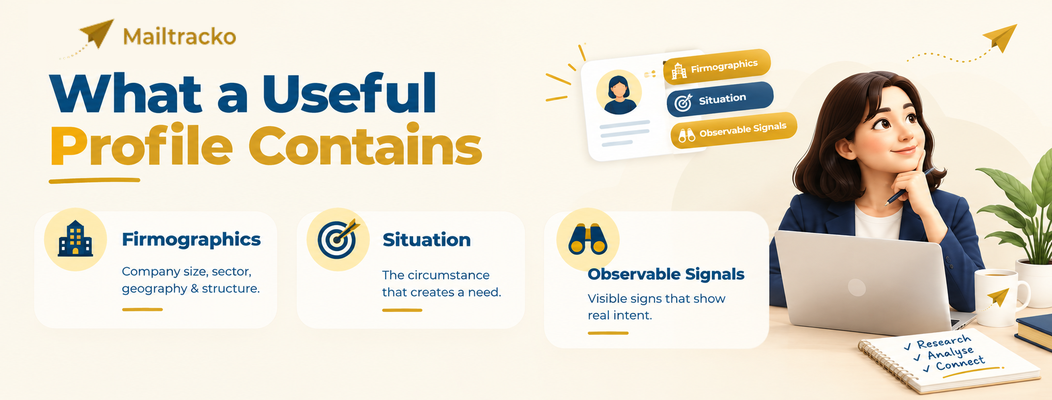
A useful profile genuinely combines firmographic facts with situational and observable signals.
Firmographics
Company size, sector, geography and structure genuinely provide the basic filters that narrow a list from everyone to a manageable set. These are the easiest attributes to research and the least predictive on their own, which is why they are necessary but not sufficient.
Situation
The circumstance that makes a business need what you offer — a growth stage, a regulatory requirement, a particular operational model — genuinely predicts buying far better than size or sector alone. Two companies of identical size in the same sector can have completely different needs depending on their situation.
Observable Signals
Signals that can actually be seen from outside — job postings, technology used, recent announcements, published priorities — genuinely make a profile usable for prospecting. A criterion that cannot be observed before contact cannot guide who gets contacted.
Building It From Existing Customers

The best evidence for who will buy genuinely comes from who already has.
Look at Your Best Customers
The customers who bought fastest, stayed longest, paid most and caused least difficulty genuinely share characteristics worth identifying. Profiling that group, rather than all customers, produces a picture of who to find more of rather than a picture of who you happen to have.
Look at the Worst Ones Too
Customers who churned quickly, needed excessive support or never succeeded genuinely reveal who to exclude, which is as valuable as knowing who to include. Many businesses discover that a segment they pursue actively is one that consistently fails.
Ask Why They Bought
Asking good customers what prompted them to look for a solution genuinely reveals the trigger that turned a need into a purchase. That trigger frequently becomes the most useful signal in the profile, because it identifies the moment to approach similar businesses.
From Profile to Prospect List
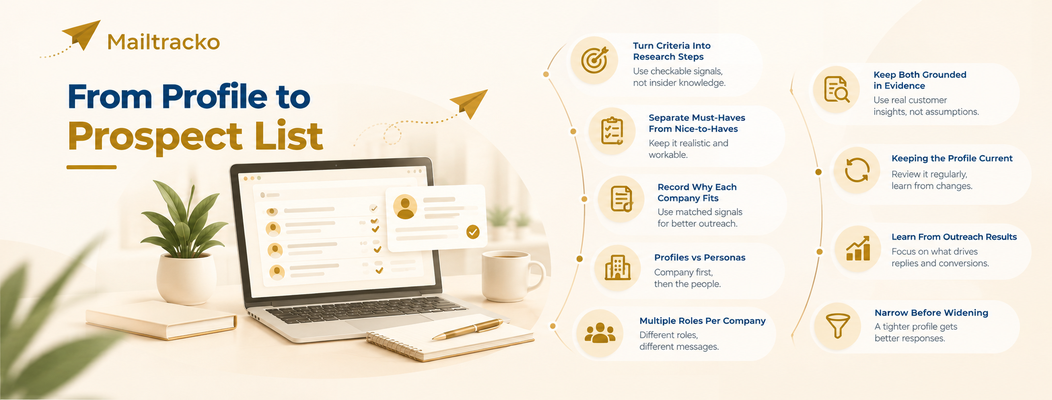
A profile genuinely earns its value when a researcher can use it to decide who belongs on a list.
Turn Criteria Into Research Steps
Each criterion genuinely should correspond to something a researcher can check — a directory filter, a website detail, a public signal. Criteria that require insider knowledge cannot be applied before contact and should be moved to qualification instead.
Separate Must-Haves From Nice-to-Haves
Distinguishing criteria that disqualify from criteria that simply increase fit genuinely prevents a profile so strict that no company qualifies. A short list of must-haves and a longer list of positive signals is more workable than a single demanding checklist.
Record Why Each Company Fits
Noting which signals each prospect matched genuinely gives the outreach message its opening and makes later analysis possible. A column recording the matched signal is one of the most useful fields in any prospect sheet.
Profiles Versus Personas
An ideal customer profile genuinely describes companies, while a persona describes people within them.
The Company Comes First
The profile genuinely determines which organisations are worth approaching, and the persona determines who within them to contact and how. Starting with personas before settling the company profile tends to produce well-written messages to the wrong businesses.
Multiple Roles Per Company
A single target company genuinely often contains several relevant roles — the user, the budget holder, the technical evaluator — each needing a different message. The persona work happens within the boundary set by the profile.
Keep Both Grounded in Evidence
Both profiles and personas genuinely go wrong when built from assumption rather than from real customers. Invented personas with names and hobbies are less useful than a plain description of what actual buyers cared about.
Keeping the Profile Current
A profile genuinely drifts out of date as the product, market and customer base change.
Review It Periodically
Revisiting the profile every few months against recent wins and losses genuinely catches the drift that happens as a business evolves. A profile written at launch rarely describes the best customers a year later.
Learn From Outreach Results
Reply and conversion rates broken down by the signals each prospect matched genuinely show which parts of the profile predict interest. Signals that correlate with replies deserve more weight; ones that do not can be dropped.
Narrow Before Widening
When results are poor, the instinct is to widen the profile to find more prospects, and genuinely the better response is usually to narrow it. A tighter profile produces fewer prospects who respond at a much higher rate.
Defining Exclusion Criteria
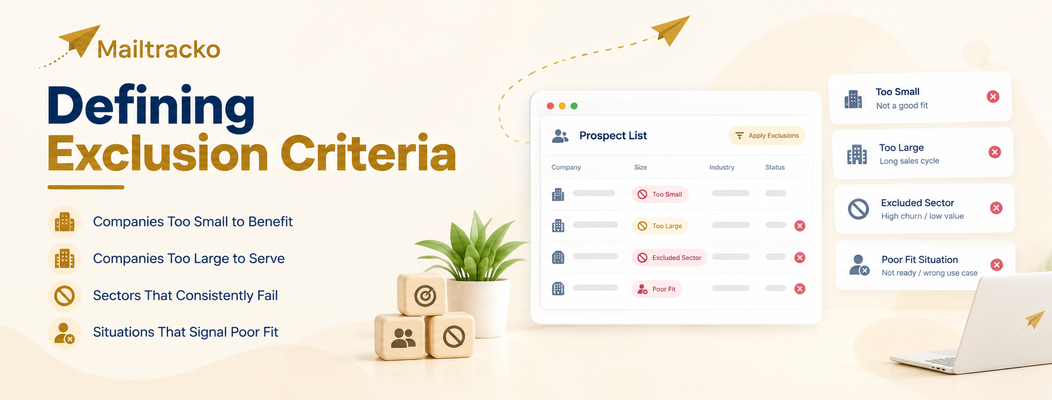
Knowing who not to target genuinely sharpens an ideal customer profile as much as knowing who to target.
Companies Too Small to Benefit
Some companies genuinely are too small to need or afford the offer, even if they fit other criteria. Setting a minimum size threshold prevents wasting time on prospects who cannot buy. The threshold should be based on evidence from existing customers rather than guesswork. Clear minimums make prospect lists more efficient.
Companies Too Large to Serve
Very large organisations genuinely may require capabilities, compliance or support that a smaller supplier cannot provide. Including them in the profile can produce long, unproductive sales cycles. Setting an upper limit keeps outreach focused on winnable accounts. The limit can rise as the business grows.
Sectors That Consistently Fail
Some sectors genuinely produce customers who churn quickly, need excessive support or never succeed with the offer. Identifying these sectors from past experience allows them to be excluded. This prevents repeating costly mistakes. Exclusions based on evidence are among the most valuable parts of a profile.
Situations That Signal Poor Fit
Certain situations genuinely indicate that a company is unlikely to benefit, such as already using a deeply embedded competitor or lacking the resources to implement a solution. Recognising these signals during research prevents wasted outreach. They can be added to the profile as disqualifiers. Clear disqualifiers make research faster.
Communicating the Profile to the Team
An ideal customer profile genuinely only works if everyone doing outreach understands and applies it the same way.
Write It Down Clearly
A written profile genuinely ensures that everyone uses the same criteria, rather than relying on individual interpretation. It should include must-have criteria, positive signals and exclusions. Examples of good-fit and poor-fit companies make it easier to apply. A clear document reduces inconsistency across the team.
Share Examples
Showing real examples of ideal customers genuinely helps team members understand the profile more intuitively than a list of criteria. Examples make abstract criteria concrete. They also help new team members learn quickly. A few well-chosen examples are often more useful than a long description.
Review It Together
Discussing the profile as a team genuinely surfaces disagreements and gaps before they affect outreach. Team members who talk to prospects often notice patterns that the profile misses. Regular reviews keep the profile aligned with reality. Shared ownership encourages consistent use.
Connect It to the Prospect Sheet
Adding profile criteria as columns in the shared prospect sheet genuinely makes the profile part of daily work rather than a separate document. Researchers can record which criteria each prospect meets. This also allows later analysis of which criteria predict success. Integration keeps the profile practical.
ICPs for Different Stages of a Business
An ideal customer profile genuinely evolves as a business grows.
Early Stage
Early-stage businesses genuinely often target customers who value flexibility and direct attention. These customers may accept less mature products. The profile focuses on accessibility and willingness to experiment. Early customers provide valuable feedback.
Growth Stage
As a business grows, genuinely the profile can shift towards customers who provide more predictable revenue. Evidence from early customers informs this change. Targeting becomes more selective. Growth-stage profiles balance opportunity and efficiency.
Established Stage
Established businesses genuinely may target larger or more complex customers. They have the resources and credibility to serve them. The profile reflects proven capabilities. Expansion into new segments may also occur.
Reassess Regularly
Regular reassessment genuinely ensures the profile matches the current stage of the business. Outdated profiles lead to inefficient targeting. Reviewing performance data helps guide updates. Adaptation supports long-term success.
Validating the Profile With Outreach Data
Outreach results genuinely provide the fastest feedback on whether an ideal customer profile is accurate.
Compare Replies by Segment
Breaking down reply rates by the segments in the profile genuinely shows which parts of it produce engagement. A segment with consistently strong replies deserves more focus. A segment with poor results may need to be narrowed or removed. This analysis turns outreach into ongoing market research.
Track Signals Against Outcomes
Recording which buying signals each prospect showed genuinely allows later comparison with who replied and converted. Signals that predict success can be weighted more heavily. Signals that predict nothing can be dropped. The profile becomes more accurate with each campaign.
Listen to What Replies Say
The content of replies genuinely reveals how prospects describe their own problems and priorities. That language can refine both the profile and the messaging. Objections also show where the profile includes companies that do not fit. Replies are rich qualitative data.
Adjust in Small Steps
Changing the profile dramatically after a single campaign genuinely risks overreacting to noise. Small adjustments based on consistent patterns are safer. Over several campaigns, the profile converges on the most responsive customers. Steady refinement beats sudden overhaul.