How to Monitor Deliverability When You Are Below the Postmaster Threshold
By Julia Morgan · Published 2026-10-24 · Updated 2026-10-26
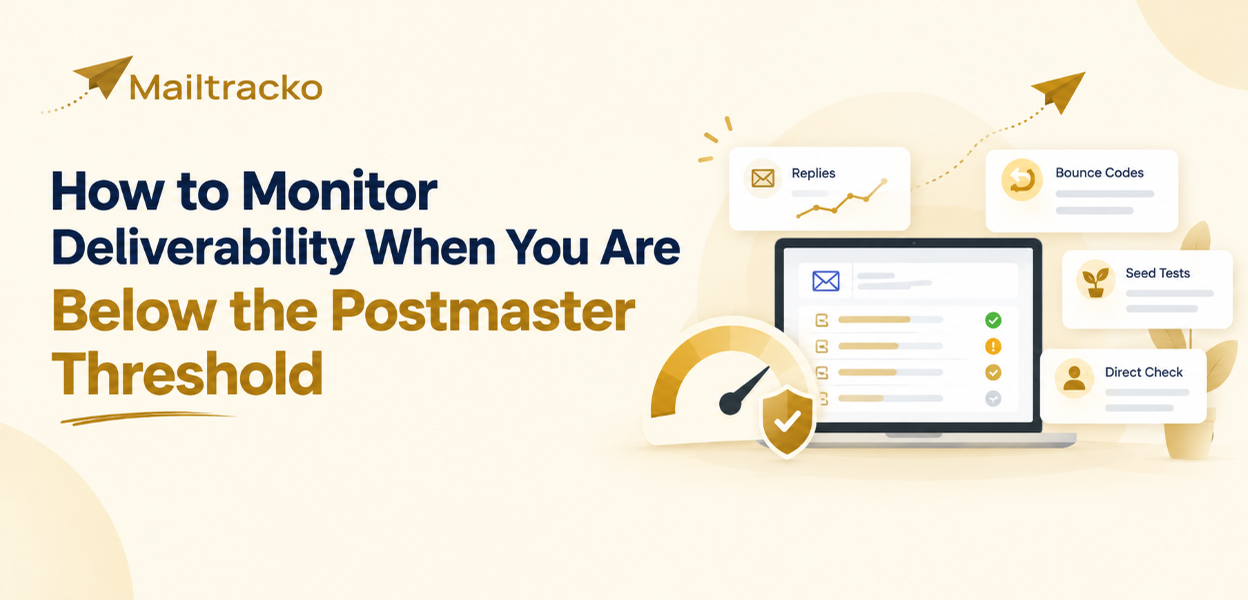
Almost every piece of deliverability advice recommends watching provider dashboards for complaint rates and reputation data. Almost none of it mentions that those dashboards require sending enough volume to a single provider before they report anything, and that a consultant sending fifty messages a week will never reach that threshold.
This leaves a substantial category of sender in an odd position. They are told to monitor signals they cannot see, and the absence of data is frequently mistaken for the absence of a problem. A low-volume sender with a developing reputation problem learns about it when replies stop, which is late and ambiguous.
The available signals are different rather than absent. This guide covers what a low-volume sender can actually observe, which indicators move first, how to run a simple monitoring routine, what to check after any change, and why prevention carries more weight at this scale.
Quick Answer: Watch reply rate as the primary signal, since it requires no tooling and moves before anything else visible. Read bounce codes after every send, run an occasional seed test against the providers your recipients use, and ask a few recipients directly where messages landed. These substitute adequately for dashboards at low volume.
What You Can Actually Observe

A low-volume sender genuinely has four usable signals, none of which requires provider tooling.
Reply Rate Is the Primary Indicator
Replies require a human to read and respond, which genuinely makes reply rate the most reliable available signal and one that no privacy feature distorts. A sustained fall with no change in list or message is the clearest warning a small sender receives, and it arrives before anything else is visible.
Bounce Codes Carry Diagnosis
The text and codes in bounce messages genuinely distinguish a data problem from a policy rejection, and policy rejections are the direct evidence of a reputation issue that a dashboard would otherwise provide. Reading them after each send is the closest substitute for provider reporting available.
Seed Tests Show Placement
A handful of accounts across the relevant providers genuinely shows where mail is landing, which no other method reveals. At low volume this is occasional rather than routine, and it is the check that converts a suspicion into a fact.
Which Signals Move First
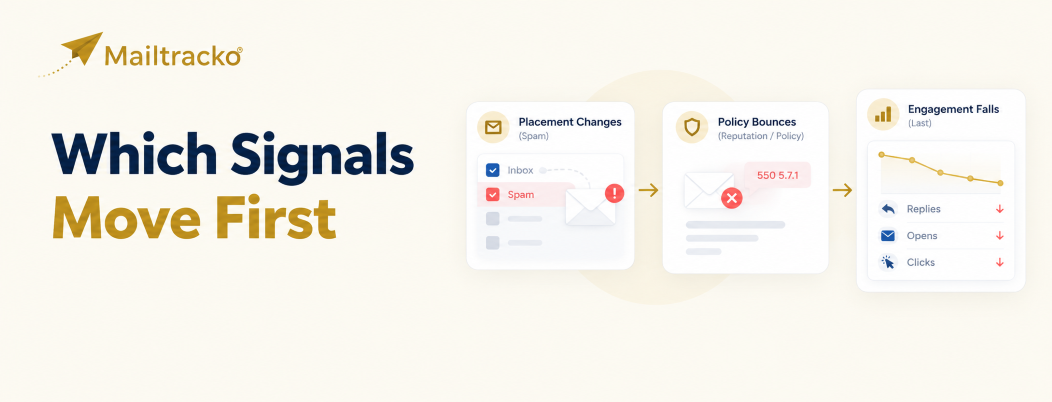
The signals genuinely appear in a predictable order, which makes the early ones worth watching closely.
Placement Changes Before Replies Fall
Mail moving to spam genuinely reduces replies with a lag, because the placement changes immediately and the reply decline becomes visible only across several campaigns at low volume. This lag is why a small sender's first indication is usually ambiguous rather than clear.
Policy Bounces Are the Earliest Hard Evidence
A rejection citing reputation or policy genuinely appears as soon as a receiver decides to refuse rather than filter, which makes it earlier and more definite than any engagement signal. A single such bounce from a major provider is worth more attention than a week of slightly lower opens.
Engagement Falls Last and Most Ambiguously
By the time reply rate has clearly fallen at low volume, the cause has genuinely been operating for weeks. This is the argument for watching bounce codes rather than waiting for engagement data to become statistically convincing, which at fifty messages a week it rarely does.
A Monitoring Routine That Fits

A few minutes after each campaign genuinely covers what a low-volume sender needs.
After Every Send
Read the bounce messages rather than the bounce count, remove hard bounces, and note anything mentioning policy or reputation. This genuinely takes a few minutes and it is where the earliest evidence appears, which makes it the most valuable habit at this scale.
Monthly
Compare reply rate against the previous months, check the domain against the major blocklists, and confirm that a delivered message still passes authentication. All three are quick, and the last catches the silent breakage that follows infrastructure changes.
Quarterly
Run a seed test across the providers your recipients use and review whether the list has accumulated contacts who never engage. At low volume this cadence is sufficient, and doing it on a schedule prevents it being remembered only during a crisis.
Asking Recipients Directly
The most underused monitoring technique at low volume is genuinely asking people where the message arrived.
It Produces Better Data Than Any Tool
A recipient can tell you whether a message reached their inbox, their spam folder or a category tab, and whether their organisation added a warning banner. This genuinely exceeds what seed testing provides because it describes a real recipient's environment rather than a controlled account.
Ask the Ones You Already Speak To
Existing contacts, clients and colleagues at other organisations genuinely answer this question without difficulty, and two or three answers resolve most placement questions. It costs one sentence in a conversation that was happening anyway.
Corporate Recipients Reveal the Most
Recipients at organisations with security gateways genuinely see things a consumer account does not — quarantine notices, external sender warnings, rewritten links — and none of it is visible from the sending side. These are the recipients worth asking, particularly for a B2B sender.
Why Prevention Matters More at This Scale
With limited visibility, prevention genuinely does the work that monitoring does for larger senders.
You Will Learn About Problems Late
A low-volume sender genuinely cannot detect a developing problem as quickly as a larger one, which means the margin for error is smaller rather than larger. The practices that prevent problems matter more precisely because the warning systems are weaker.
The Practices Are the Same
Correct authentication, a clean well-sourced list, consistent volume and relevant messages genuinely prevent nearly everything a dashboard would warn about. None of these requires volume to implement, which means a small sender can achieve the outcome without the visibility.
Low Volume Is Itself an Advantage
A mailbox sending a few dozen messages a day genuinely resembles ordinary correspondence, which is the pattern filtering systems treat most favourably. Tools such as MailTracko sending through Gmail sit in this position, where the absence of monitoring matters less because the risk profile is lower.
Reaching the Threshold

Some senders genuinely can reach reporting thresholds, and it is worth knowing whether you are one of them.
The Threshold Is Per Provider
Reporting requires enough volume to a single provider rather than across all sending, which genuinely means a sender split evenly across several providers may reach none of the thresholds despite meaningful total volume. Understanding this explains why a sender with reasonable overall numbers still sees nothing, and it identifies whether concentrating sending would change anything.
Register the Domain Anyway
Registering with the provider dashboards costs nothing and genuinely means data appears immediately if volume ever crosses the line, rather than starting from the registration date afterwards. Senders who register only when they want the data discover they have no history to look at.
Consolidate Sending Domains
An organisation sending from several domains genuinely splits its volume across them, which can keep each below the threshold when the combined figure would be above it. Consolidating is worth considering for the visibility alone, alongside the other arguments for fewer domains.
Accept It If You Cannot
A genuinely small sender will not reach these thresholds and should not distort their sending to do so, since volume for the sake of visibility is the wrong trade entirely. The substitutes are adequate and the low-volume sending pattern is itself favourable, which makes this a reasonable position rather than a compromise.
What Not to Worry About
Small senders genuinely spend attention on metrics that mean little at their scale.
Open Rate Is Largely Noise Now
Automatic image loading and privacy protections genuinely inflate and distort open figures to the point where small differences describe nothing, and at low volume the sample compounds the problem. Watching it closely produces conclusions that are not supported by the data, and reply rate answers the same question better.
Industry Benchmarks Do Not Apply
Published benchmark figures genuinely come from volume senders in particular sectors with particular list types, and comparing a fifty-message personalised campaign against them is not meaningful. Your own previous results are the only comparison that describes anything real.
Send-Time Optimisation
Small differences in send time genuinely cannot be detected at low volume, and delivery delays from greylisting and queuing distort the measurement further. The effort spent testing this produces nothing at this scale and is better directed at targeting.
Single Bad Sends
One campaign performing poorly genuinely tells you very little at low volume, since the variation between small samples is large. Reacting to each send produces changes based on noise, and the trend across several is the only signal worth acting on.
Building Your Own Simple Dashboard
A low-volume sender genuinely can assemble useful monitoring from a spreadsheet.
Four Columns Cover It
Date, messages sent, replies received and bounces by type genuinely constitute everything a small sender needs to see a trend, and recording them after each campaign takes two minutes. This is considerably more useful than any dashboard the sender cannot access, because it measures the thing that matters rather than a proxy for it.
Split by Recipient Provider
Adding a breakdown of replies by recipient domain genuinely reveals a placement problem at one provider that the overall figure conceals, which is the most common blind spot for a B2B sender. This is one additional column and it answers a question most senders never ask.
Record Changes Alongside
Noting when the template changed, the list source changed or an authentication record was updated genuinely allows subsequent movements to be attributed, which is impossible when only the numbers are kept. The annotations are what turn a record of results into an explanation of them.
Look at It Monthly
Reviewing the sheet once a month, rather than after each send, genuinely produces conclusions based on a trend rather than on noise. At low volume any single campaign says very little, and the monthly view is the smallest window that supports a judgement.