Supplier Negotiation Emails Asking for Better Terms
By Julia Morgan · Published 2026-10-30 · Updated 2026-10-09
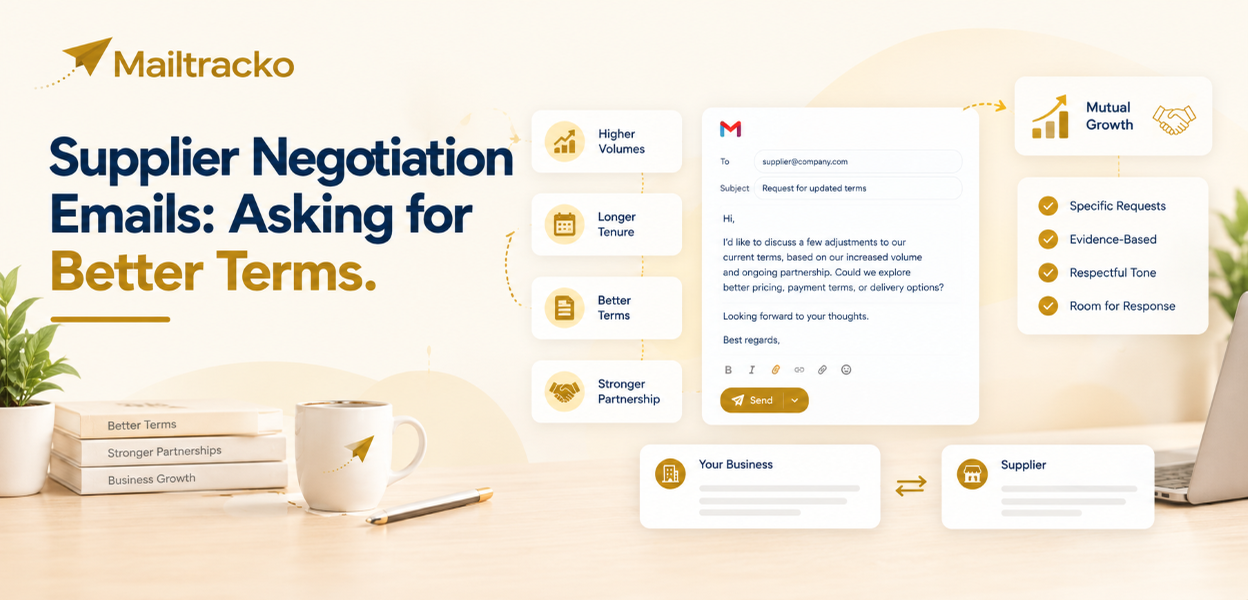
Most small businesses accept their suppliers' terms far longer than they need to. The original price was agreed when volumes were small, payment terms were set by the supplier's standard form, and nobody has revisited them since because the relationship works well enough. Meanwhile the business has grown, orders have become regular, and the supplier would genuinely rather keep a reliable customer than lose one over a reasonable request.
Negotiating by email suits this kind of conversation well. It gives both sides time to think, it creates a written record of what was agreed, and it lets the buyer set out their case clearly without the pressure of a phone call. The difficulty is that many negotiation emails are either too vague to act on, such as a general request for 'a better deal', or too aggressive, leaning on threats to switch suppliers that both sides know are unlikely to be carried out.
A good supplier negotiation email is specific, evidence-based and respectful of the relationship. It explains what has changed, asks for particular terms and leaves the supplier room to respond with alternatives. This guide covers when to negotiate, how to prepare, what terms to ask for, how to write the email, sample templates, protecting the relationship, and how to manage supplier emails with MailTracko.
Quick Answer: Ask suppliers for better terms by email when something has genuinely changed, such as higher volumes, longer tenure or a competing quote. Prepare your evidence, ask for specific terms like price, payment days or delivery, explain the benefit to the supplier and leave room for a counter-offer. Keep it courteous, factual and never bluff.
When It Makes Sense to Negotiate
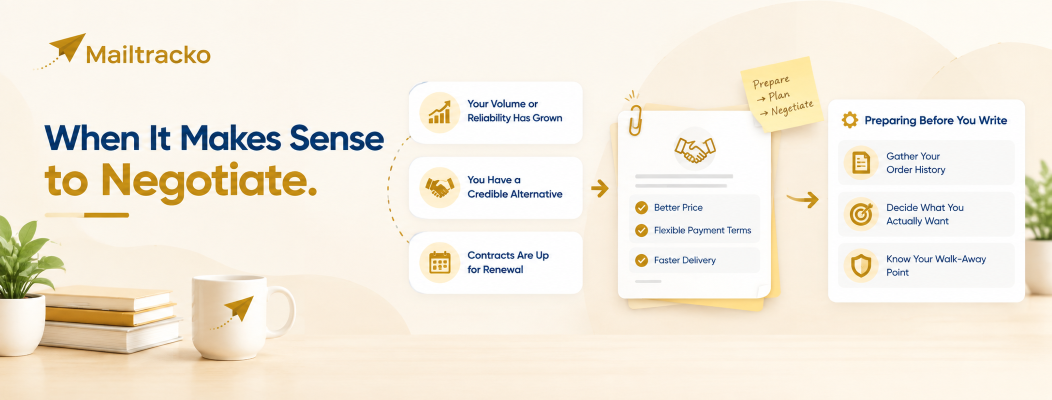
Negotiating genuinely works best when there is a clear reason the terms should change, rather than a general wish to pay less.
Your Volume or Reliability Has Grown
A business that orders more, more regularly or pays reliably has become a more valuable customer since the original terms were agreed. That change is genuinely the strongest basis for a request, because it gives the supplier a reason to reward the relationship rather than simply concede margin.
You Have a Credible Alternative
A comparable quote from another supplier gives a negotiation real weight. It should be genuinely comparable in quality, service and delivery, because a cheaper quote for an inferior product is easy for the supplier to dismiss and may weaken your position.
Contracts Are Up for Renewal
Renewal dates are natural points to review terms, and suppliers expect it. Starting the conversation a few weeks before renewal genuinely gives both sides time to agree changes without the pressure of an expiring contract.
Preparing Before You Write
The work before the email genuinely decides the outcome, because a well-prepared request is hard to refuse and easy to act on.
Gather Your Order History
Pull together order volumes, spend over the past year and your payment record. Specific figures from your own records are genuinely more persuasive than general claims about being a good customer.
Decide What You Actually Want
Choose one or two priorities, such as a lower unit price, longer payment terms or faster delivery. A focused request genuinely gets a clearer answer than a long list of demands the supplier has to work through.
Know Your Walk-Away Point
Decide in advance what you would accept and what would make you look elsewhere. Knowing this genuinely keeps the negotiation calm, because you are not deciding under pressure when the reply arrives.
What Terms to Ask For
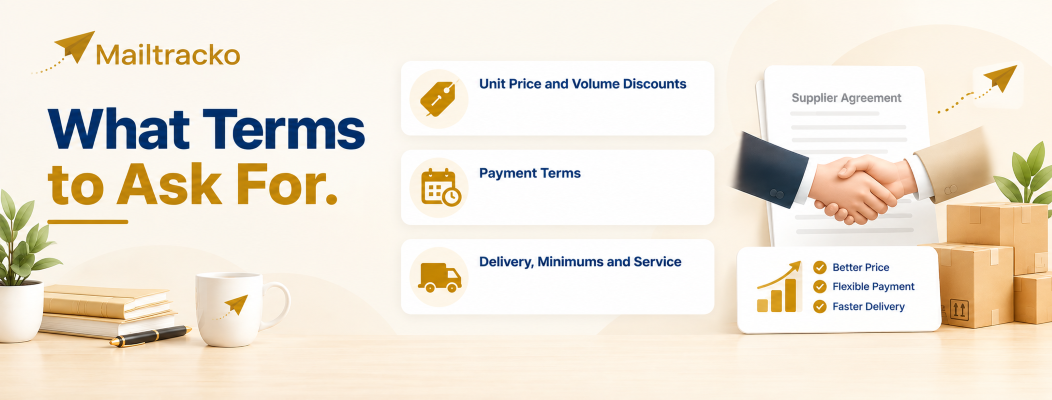
Price is only one lever, and suppliers genuinely often find it easier to move on payment terms, volumes or delivery than on unit cost.
Unit Price and Volume Discounts
A lower price in exchange for committed volumes gives the supplier something in return. Tiered pricing, where the price drops as volumes rise, genuinely aligns both sides' interests and can be easier to agree than a flat cut.
Payment Terms
Longer payment terms can help a small business's cash flow significantly, while some suppliers will offer a discount for early payment instead. Asking which the supplier prefers genuinely opens a practical conversation rather than a tug of war.
Delivery, Minimums and Service
Lower minimum order quantities, faster delivery or included shipping can be worth as much as a price reduction. These terms genuinely cost some suppliers less to offer, which makes agreement more likely.
How to Write the Negotiation Email
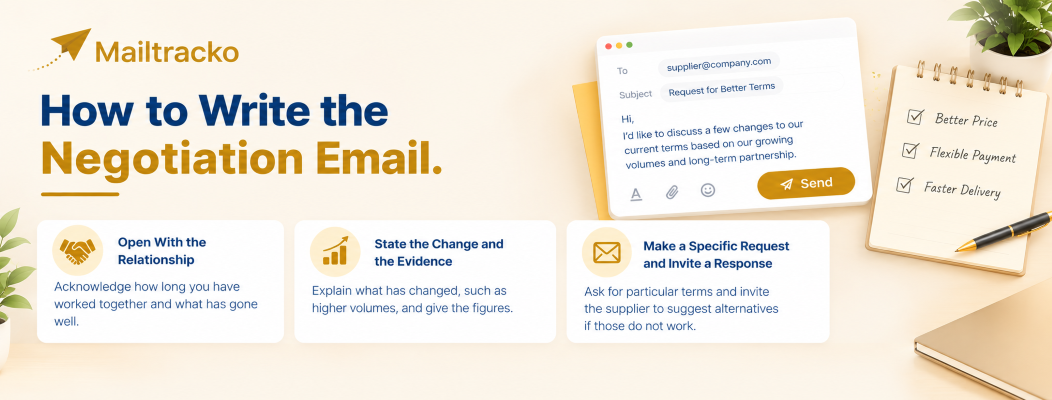
A strong negotiation email genuinely states the context, the evidence and the specific request in a few short paragraphs.
Open With the Relationship
Acknowledge how long you have worked together and what has gone well. It genuinely sets a cooperative tone and reminds the supplier what is at stake without any need for threats.
State the Change and the Evidence
Explain what has changed, such as higher volumes, and give the figures. Evidence genuinely moves the conversation from opinion to facts both sides can check.
Make a Specific Request and Invite a Response
Ask for particular terms and invite the supplier to suggest alternatives if those do not work. Leaving room for a counter-offer genuinely keeps the negotiation open rather than forcing a yes or no.
Sample Supplier Negotiation Emails
These templates genuinely work best with real figures from your own records in place of the placeholders.
Asking for a Volume Discount
Subject: Reviewing pricing for {{product}}
Hi {{First Name}},
We have really valued working with {{Supplier}} over the past {{time period}}. Our orders of {{product}} have grown from {{previous volume}} to {{current volume}} a month, and we expect that to continue. Could we discuss a price of {{target price}} per unit at this volume?
If that is difficult, I would welcome any alternative you can suggest.
{{Sender Name}}
Asking for Longer Payment Terms
Subject: Payment terms for {{Company}}
Hi {{First Name}},
We have paid every invoice on time for {{time period}}. To help our cash flow as we grow, would you consider moving our terms from {{current terms}} to {{requested terms}}? Our order volumes would stay the same or increase.
Thank you,
{{Sender Name}}
Responding With a Competing Quote
Subject: Pricing for {{product}} at renewal
Hi {{First Name}},
Ahead of our renewal, we have received a quote of {{competing price}} for comparable {{product}}. We would genuinely prefer to stay with {{Supplier}}. Is there any flexibility on {{price or term}}?
{{Sender Name}}
Protecting the Relationship While You Negotiate
A negotiation that damages the relationship genuinely costs more in the long run than the savings it produces.
Never Bluff About Alternatives
Claiming a competing quote you do not have, or threatening to leave when you would not, is easy for experienced suppliers to test. Getting caught genuinely undermines every future negotiation with that supplier.
Do Not Squeeze Too Hard
A supplier pushed below a sustainable margin may cut corners on quality, delivery or service, or prioritise other customers when capacity is tight. Fair terms genuinely protect the reliability you depend on.
Confirm What Was Agreed in Writing
Once terms are agreed, send a short email summarising them, with effective dates. A written summary genuinely prevents misunderstandings months later, when the details are no longer fresh.
Managing Supplier Emails With MailTracko
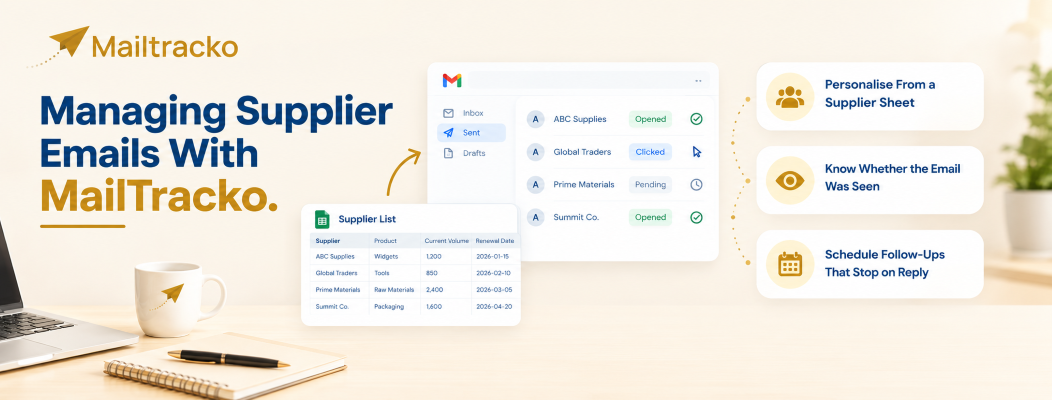
When a business deals with several suppliers, MailTracko genuinely helps keep negotiation emails organised, personalised and followed up from inside Gmail.
Personalise From a Supplier Sheet
A Google Sheet with columns such as {{Supplier}}, {{product}}, {{current volume}} and {{renewal date}} lets you send individually worded review requests through MailTracko's mail merge without retyping figures. Each email still reads as a personal message, because it genuinely contains that supplier's own numbers.
Know Whether the Email Was Seen
MailTracko's open and click tracking can show whether a supplier has likely looked at your request, which helps judge when to follow up. Opens are genuinely an imperfect signal, since some mail systems load images automatically, so treat them as a hint rather than proof.
Schedule Follow-Ups That Stop on Reply
Negotiation emails are easy to forget during a busy week. Setting a polite follow-up that sends only if the supplier has not replied genuinely keeps conversations moving without the risk of chasing someone who already answered.
Handling the Supplier's Reply
The supplier's reply genuinely begins the real negotiation, so it deserves as much thought as the original request.
When the Supplier Makes a Counter-Offer
A counter-offer is usually a good sign, because it shows the supplier wants to keep the business. Compare it calmly with your priorities and walk-away point rather than reacting to the headline number. It is genuinely reasonable to accept part of an offer and ask for movement on another term, such as agreeing the price while asking for longer payment days.
When the Supplier Says No
A refusal is not necessarily final, especially if the supplier explains the reason, such as rising costs of their own. Asking what would make a change possible, such as a longer commitment or larger orders, genuinely keeps the conversation productive. If nothing can move, thank them and decide calmly whether to stay or explore alternatives.
Get the Final Terms in Writing
Once terms are agreed, summarise them in a short email with the effective date and ask the supplier to confirm. Updating purchase orders or contracts promptly genuinely prevents old terms being applied by mistake on the next invoice.