What Is Data Enrichment and When Is It Worth Paying For
By Julia Morgan · Published 2026-10-31 · Updated 2026-10-09
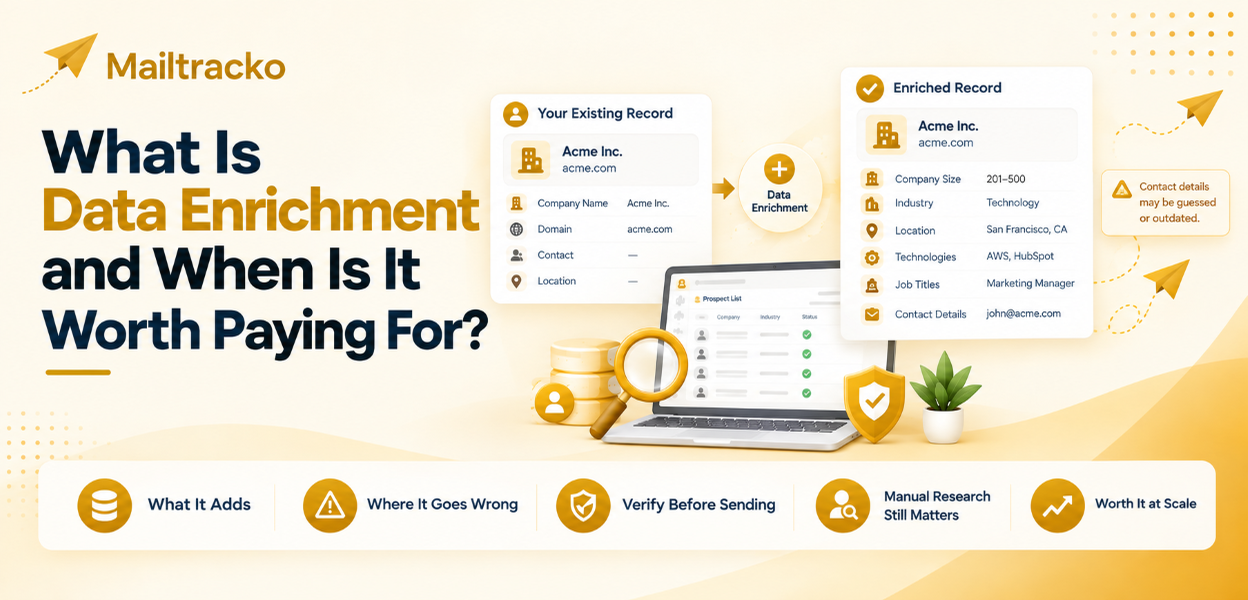
Data enrichment is the process of adding information to records you already hold. Start with a company name or a person's name and domain, run it through an enrichment service, and receive back fields such as company size, industry, location, technology used, job titles and contact details. For a team building prospect lists, the appeal is obvious: less manual research, more complete records.
The appeal and the reality differ in important ways. Enrichment data varies considerably in accuracy, goes stale quickly and is sometimes inferred rather than verified. Contact details in particular can be guessed from patterns, and a list enriched with guessed addresses produces bounces that damage the sending domain.
Whether enrichment is worth paying for depends on what you need it for and how much you can verify. This guide covers what enrichment adds, where it goes wrong, the data protection questions, how it compares with manual research, and how to decide.
Quick Answer: Data enrichment adds missing fields — company size, industry, technology, titles, contact details — to records you already hold. It is most valuable for firmographic filtering at scale and least reliable for contact details, which go stale and are sometimes inferred. It also carries data protection obligations when it adds personal data.
What Enrichment Adds
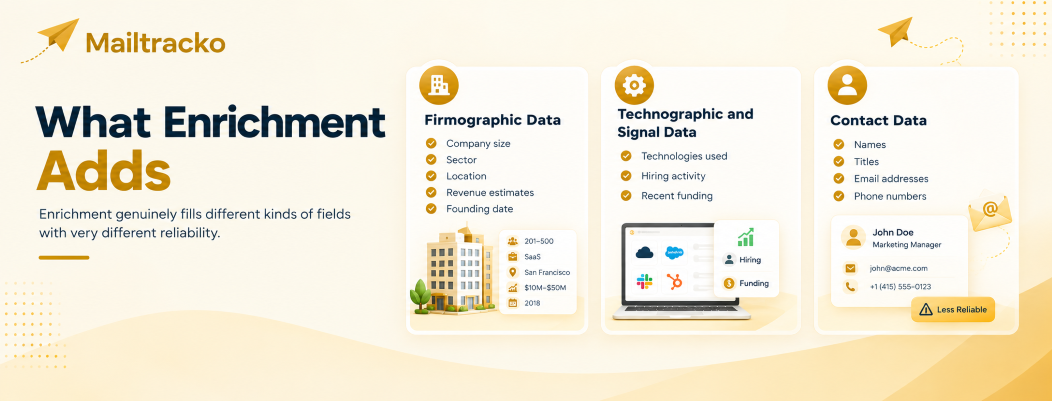
Enrichment genuinely fills different kinds of fields with very different reliability.
Firmographic Data
Company size, sector, location, revenue estimates and founding date genuinely tend to be the most reliable enrichment fields, because they change slowly and come from multiple public sources. For filtering a large list against an ideal customer profile, this data saves considerable time.
Technographic and Signal Data
Information about which technologies a company uses, hiring activity or recent funding genuinely helps identify buying signals, and it varies more in accuracy. Some of it is detected directly, while some is estimated, and knowing which is which matters for how much weight to give it.
Contact Data
Names, titles, email addresses and phone numbers genuinely are the most requested enrichment fields and the least reliable. People change roles frequently, and email addresses are sometimes constructed from a naming pattern rather than confirmed to exist.
Where Enrichment Goes Wrong
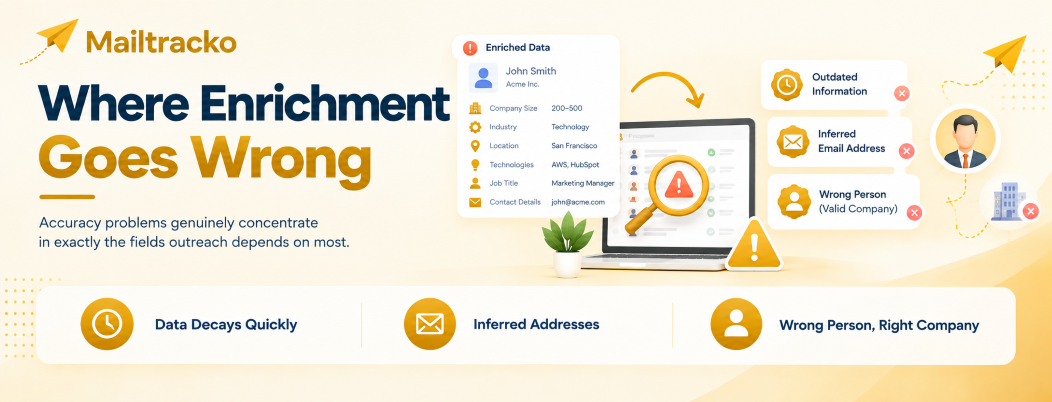
Accuracy problems genuinely concentrate in exactly the fields outreach depends on most.
Data Decays Quickly
Business contact data genuinely decays continuously as people change jobs, companies restructure and domains change. Enriched data that was accurate when collected may be substantially out of date by the time it is used, and providers vary widely in how frequently they refresh.
Inferred Addresses
Some enrichment genuinely constructs email addresses from a person's name and the company's known format, which produces plausible addresses that may not exist. At catch-all domains nothing confirms them, and sending to them produces either bounces or silent failures.
Wrong Person, Right Company
Enrichment genuinely frequently returns someone at the right company in a role that does not own the problem, because the matching is based on title keywords. A message reaching the wrong role is almost as ineffective as one reaching the wrong company.
Data Protection Questions
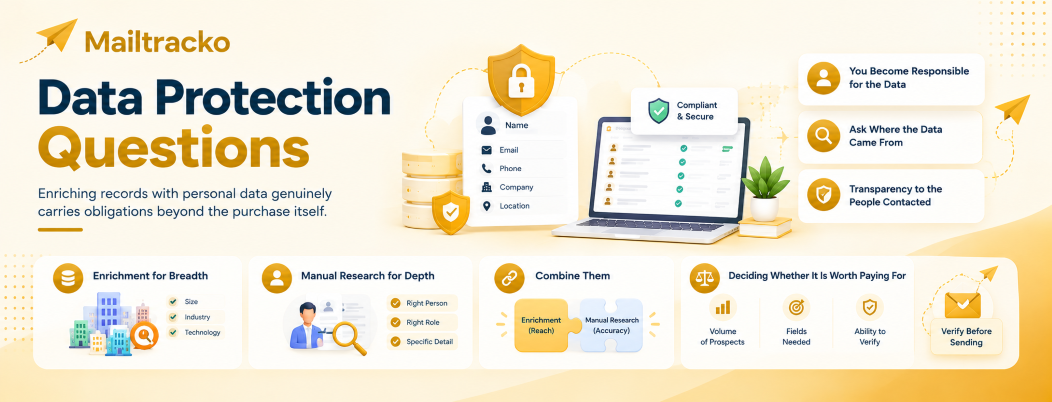
Enriching records with personal data genuinely carries obligations beyond the purchase itself.
You Become Responsible for the Data
Adding personal data about individuals to your records genuinely makes you responsible for processing it lawfully in jurisdictions with data protection law. Buying the data from a provider does not transfer that responsibility, and you need a lawful basis for using it.
Ask Where the Data Came From
Understanding how a provider collected its data, and on what basis, genuinely matters because data collected unlawfully does not become lawful when resold. Reputable providers can explain their sourcing; vague answers are a warning sign.
Transparency to the People Contacted
Some regimes genuinely require informing individuals when their data was obtained from a third party, and people who ask where you got their details should receive a truthful answer. Being unable to say where a contact came from is both a compliance and a trust problem.
Enrichment Versus Manual Research
The two genuinely suit different parts of the prospecting process.
Enrichment for Breadth
Filtering thousands of companies by size, sector and technology genuinely is where enrichment earns its cost, because doing it manually would take far longer. Firmographic enrichment at the top of the funnel is its most defensible use.
Manual Research for Depth
Identifying the right person, confirming they still hold the role and finding a specific detail for the opening line genuinely remain tasks where manual research outperforms enrichment. These are also the steps that most determine whether a message gets a reply.
Combine Them
Using enrichment to narrow a large universe and manual research to finalise contacts and personalisation genuinely combines the strengths of both. This workflow uses enrichment where it is reliable and avoids depending on it where it is not.
Deciding Whether It Is Worth Paying For
The decision genuinely depends on volume, the fields needed and the ability to verify.
Small Lists Rarely Need It
A team researching a few dozen prospects a week genuinely gains little from enrichment, because manual research at that volume is both feasible and more accurate. The cost becomes easier to justify as volume grows beyond what manual research can cover.
Test Accuracy Before Committing
Running a sample of known records through a provider and checking the results genuinely reveals its real accuracy for your market. Providers vary widely by region and sector, and a trial is more informative than any claimed accuracy figure.
Always Verify Before Sending
Whatever the source, genuinely verifying email addresses before sending protects the domain from bounces. Enriched contact data should be treated as a starting point for verification rather than as sendable data, particularly when it feeds a merge tool such as MailTracko sending from your own mailbox.
Choosing an Enrichment Provider
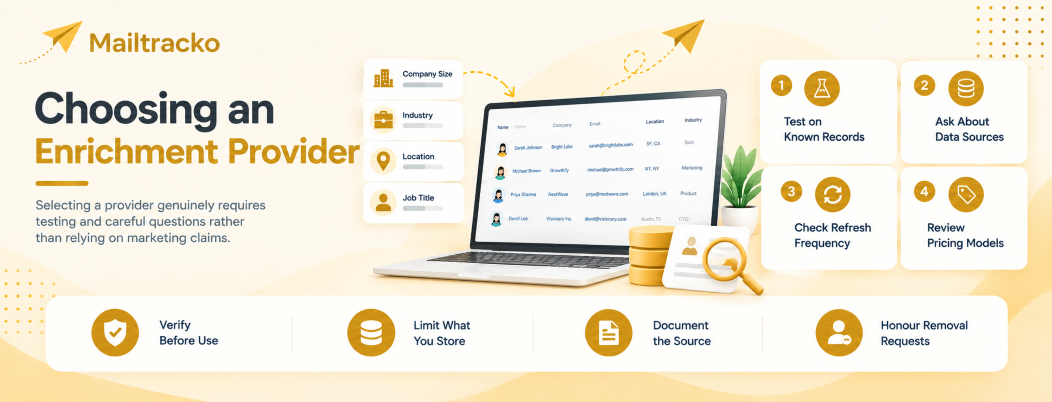
Selecting a provider genuinely requires testing and careful questions rather than relying on marketing claims.
Test on Known Records
Running a sample of records whose details you already know through a provider genuinely reveals its real accuracy. This test is more reliable than any claimed accuracy figure. Differences by region, sector and company size often become apparent. Testing before committing prevents expensive mistakes.
Ask About Data Sources
Understanding where a provider obtains its data genuinely helps assess both accuracy and legality. Reputable providers can explain their sources and collection methods. Vague answers are a warning sign. Data sourcing affects both quality and compliance.
Check Refresh Frequency
How often a provider updates its data genuinely affects how current the information is. Contact data decays quickly, so frequent updates matter. Providers that rarely refresh data may deliver outdated results. Asking about refresh cycles helps set expectations.
Review Pricing Models
Enrichment pricing genuinely varies, including per-record, subscription and credit-based models. Understanding the model helps estimate total cost. Some providers charge even when data is missing or inaccurate. Clear pricing makes comparisons easier.
Using Enriched Data Responsibly
Enriched data genuinely should be handled carefully once it enters your systems.
Verify Before Use
Enriched contact details genuinely should be verified before being used for outreach. Verification reduces bounces and protects deliverability. Treating enriched data as a starting point rather than a final answer is sensible. This step is especially important for email addresses.
Limit What You Store
Storing only the data needed for outreach genuinely reduces risk and simplifies compliance. Collecting large amounts of unnecessary personal data increases exposure. Minimal storage is easier to manage and justify. It also keeps records focused.
Document the Source
Recording where each piece of data came from genuinely helps answer questions from prospects and regulators. It also makes it easier to correct or remove data when needed. Clear documentation supports transparency. It is good practice even when not strictly required.
Honour Removal Requests
Anyone who asks to have their data removed genuinely should have that request handled promptly. Maintaining a suppression list prevents re-adding them from enrichment sources later. This protects both compliance and reputation. Tools such as MailTracko that track replies help identify these requests.
Alternatives to Paid Enrichment
Several approaches genuinely provide enrichment-like benefits without a paid service.
Company Websites
Company websites genuinely provide accurate information about products, services and team members. They are often more current than third-party databases. Researching websites directly improves accuracy. It also supports personalisation.
Public Records
Public business records genuinely provide information such as company size and location. These records are often reliable. They can support firmographic filtering. Access varies by country.
Professional Networks
Professional networks genuinely help identify roles and responsibilities. Manual research provides accurate and current information. It stays within platform rules. It supports targeted outreach.
Customer Referrals
Referrals from existing customers genuinely provide warm leads with accurate information. They often convert better than cold prospects. Asking for referrals builds relationships. It reduces reliance on purchased data.
Enrichment and Deliverability
Enriched data genuinely has a direct effect on email deliverability, which is often overlooked.
Bounces From Bad Data
Enriched email addresses that turn out to be invalid genuinely produce hard bounces, and high bounce rates damage sender reputation. Mailbox providers treat repeated bounces as a sign of poor list practices. That can push future messages into spam folders. Verifying enriched addresses before sending protects reputation.
Catch-All Uncertainty
Some domains genuinely accept all addresses, so verification cannot confirm whether an enriched address actually exists. Messages to these addresses may disappear without a bounce. Treating catch-all addresses cautiously and monitoring engagement helps. Low engagement from such addresses may indicate problems.
Spam Trap Risk
Poor-quality data sources genuinely can include spam trap addresses that damage reputation when mailed. Reputable providers and careful verification reduce this risk. Unusually cheap or opaque data sources deserve extra caution. Protecting the domain is worth more than a larger list.
Start Small
Sending to a small batch of enriched contacts first genuinely reveals data quality issues before they affect a large campaign. Monitoring bounces and replies from the test batch informs whether to proceed. This cautious approach limits potential damage. It also provides a real-world check on provider accuracy.