Outsourcing List Building What to Brief and What to Check
By Julia Morgan · Published 2026-10-26 · Updated 2026-10-26

List building is the most commonly outsourced part of outreach, and for understandable reasons: it is time-consuming, repetitive and does not obviously require the founder's judgement. It is also where outsourcing most frequently goes wrong, producing lists that look complete and contain companies nobody would have chosen and addresses that bounce.
The failure is usually a briefing failure. The provider was told to find businesses of a certain size in a certain sector, which is a description that includes thousands of companies and identifies none of the situational signals that actually matter. They delivered exactly what was asked for, and it was not useful.
Outsourcing works when the brief is specific and the output is checked. This guide covers what a good brief contains, how to run a paid trial before committing, what to check on delivery, how to structure payment and when the work should stay in-house.
Quick Answer: Brief the provider with specific inclusion criteria, explicit exclusions, the exact fields required and worked examples of good and poor prospects. Run a small paid trial before committing, check a sample of every delivery against the criteria, and pay for verified usable records rather than raw row counts.
What a Good Brief Contains

A brief genuinely has to be specific enough that someone unfamiliar with the business can apply it.
Inclusion Criteria in Checkable Terms
Each criterion genuinely needs to be something the provider can verify from public sources — a size range, a sector, a technology visible on the site, a stated service. Criteria requiring judgement about whether a company would benefit are not usable by someone outside the business.
Explicit Exclusions
Stating what to exclude — existing customers, competitors, companies below a size threshold, sectors that never convert — genuinely prevents the most annoying category of error. Providers cannot infer exclusions, and a list containing your own customers undermines confidence in everything else.
Worked Examples
Providing five companies that fit perfectly and five that look similar but do not genuinely conveys the criteria better than any written description. The near-miss examples are the more valuable half, because they define the boundary where judgement is required.
Specifying the Output

The format and the fields genuinely need specifying precisely, or the delivery arrives unusable.
Exact Fields and Format
Listing the columns required, in order, with an example row genuinely prevents the delivery that has to be reformatted before use. Specifying how each field should be formatted — company domain rather than name, role title as published — avoids inconsistency that causes problems in the merge.
The Personalisation Field
Where the provider is asked to supply a personalisation detail, genuinely specifying what kind of detail and giving examples is essential, or the column fills with generic observations. Many providers can do this well when told precisely what is wanted.
Source and Date Columns
Requiring a column recording where each record came from and when it was found genuinely allows quality problems to be traced to a source. It also makes it possible to identify records that have aged and need rechecking.
Running a Paid Trial

A small paid trial genuinely reveals more about a provider than any amount of discussion.
Start With a Small Batch
Commissioning a small number of records first genuinely lets both sides discover whether the brief is understood before a large commitment. Problems found in a trial are cheap; the same problems across a full list are expensive and demoralising.
Pay for the Trial
Asking for free sample work genuinely attracts providers who are desperate rather than good, and it removes any obligation to do the work properly. Paying for a trial establishes a professional relationship and produces output representative of what you would actually receive.
Check the Trial Thoroughly
Every record in a trial batch genuinely should be checked, because the sample is small enough to allow it and the findings determine whether to proceed. Patterns in the errors are more informative than the error rate itself.
Checking Every Delivery
Ongoing deliveries genuinely need sample checking, because quality drifts.
Sample Every Batch
Checking a random sample from each delivery genuinely catches the drift that occurs when a provider changes staff or starts working faster. A consistent sampling rate, applied every time, is more effective than an occasional thorough audit.
Verify the Addresses
Running delivered addresses through verification genuinely reveals whether the provider found real addresses or constructed them from patterns. A high proportion of unverifiable addresses is the clearest signal that the work was done carelessly.
Check Against Exclusions
Cross-checking the delivery against existing customers, the suppression list and current prospects genuinely catches the errors that cause the most embarrassment. This check belongs in the process rather than being left to the provider.
Paying and Managing the Relationship
How the work is paid for genuinely shapes what gets delivered.
Pay for Usable Records
Paying per row genuinely incentivises volume over quality, while paying for records that pass verification and the criteria check aligns the provider's interest with yours. This needs agreeing upfront rather than being introduced after a disappointing delivery.
Give Feedback on Rejections
Telling a provider specifically why records were rejected genuinely improves the next delivery, while simply rejecting them does not. A short note identifying the pattern is usually enough for a competent provider to correct it.
Keep the Judgement In-House
Deciding who belongs on the list genuinely remains the business's own decision, with the provider executing the criteria rather than setting them. Outsourcing the criteria as well as the work is where the most disappointing outcomes come from.
Where Outsourced List Building Goes Wrong
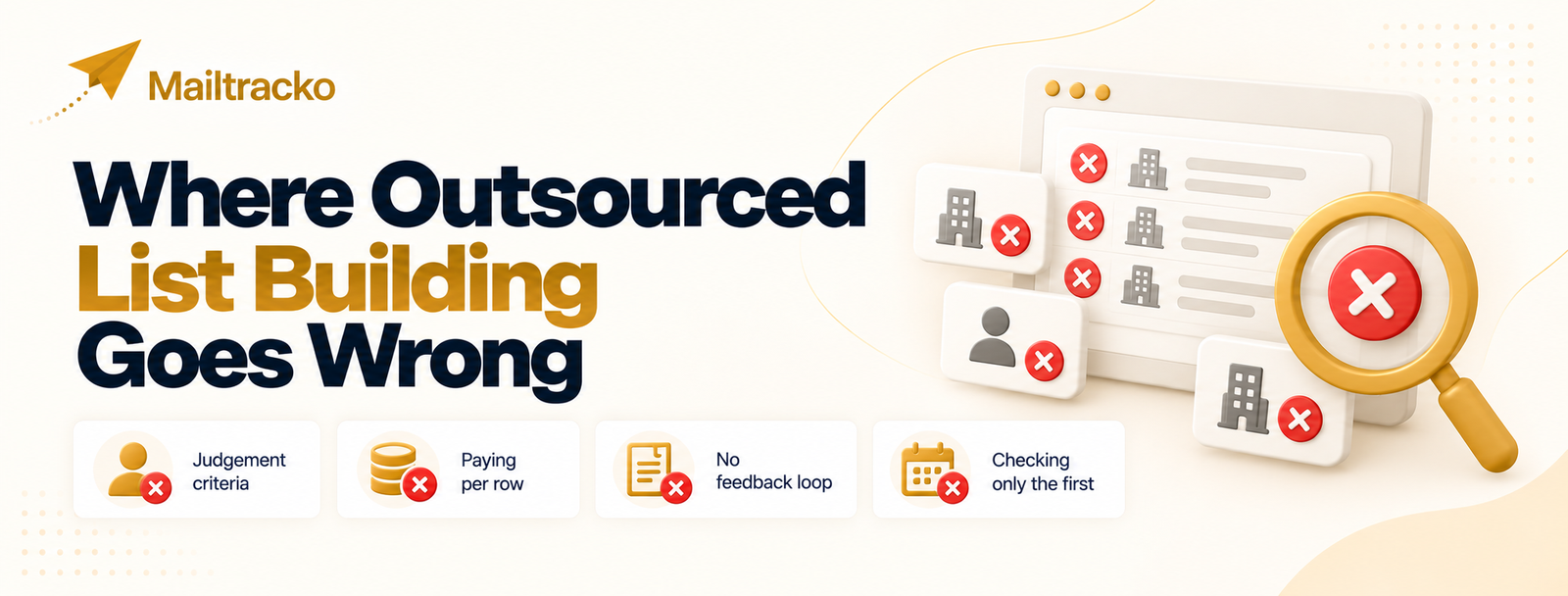
The failures genuinely follow a small number of recognisable patterns.
Criteria That Require Judgement
Asking a provider to find companies that would benefit from the product genuinely asks for a judgement they cannot make, since they do not know which customers succeed. The result is a list matching a general description rather than a specific profile. Criteria have to be checkable from public sources to be usable. Rewriting vague criteria into observable ones is usually the single biggest improvement available. This is a briefing problem rather than a provider problem.
Paying Per Row
A payment model rewarding volume genuinely produces volume, including companies that barely meet the criteria and addresses constructed from patterns. The provider is responding rationally to the incentive they were given. Paying for records that pass verification and a criteria check changes the incentive. This needs agreeing before work starts rather than after a disappointing delivery. It also makes quality discussions straightforward.
No Feedback Loop
Rejecting records without explaining why genuinely leaves the provider unable to improve, and the next delivery contains the same errors. A short note identifying the pattern usually produces a noticeable improvement. Providers rarely receive specific feedback and most respond well to it. This costs a few minutes per delivery. It is the difference between a relationship that improves and one that stays frustrating.
Checking Only the First Delivery
Quality genuinely drifts as providers change staff, take on more clients or work faster. A thorough check of the first batch followed by no checking afterwards misses this entirely. A consistent sample check on every delivery catches drift early. It also signals that quality is being monitored, which itself sustains standards. The sampling rate matters less than the consistency.
Alternatives to Full Outsourcing
Partial arrangements genuinely capture much of the benefit with less risk.
Outsource the Mechanical Half
Having a provider find and verify contacts at companies you selected yourself genuinely removes the time-consuming part while keeping the judgement in-house. This avoids the most common failure, which is a provider choosing the wrong companies. It is also easier to brief and easier to check.
Provide the Account List Yourself
Supplying the target companies and asking only for the right contact and a verified address genuinely narrows the task to something checkable. The provider cannot get the targeting wrong because they did not do it. This arrangement works particularly well for a defined addressable market.
Use a Trial Project Per Segment
Commissioning a small batch for each new segment genuinely tests whether the provider can apply the criteria in that context before a larger commitment. Performance in one segment does not guarantee performance in another. Segment-level trials keep the risk contained.
Keep Verification In-House
Running your own verification on delivered lists genuinely removes any doubt about whether it was done properly. It also gives an objective measure of delivery quality. The cost is small relative to the protection it provides for the sending domain.
Contracts and Working Terms With Providers
The terms of an outsourcing arrangement genuinely affect the quality of what arrives.
Define Acceptance Criteria
Stating in writing what constitutes an acceptable record — verified address, named contact, criteria met, personalisation detail present — genuinely gives both sides a shared standard. Without it, quality disputes become subjective. Acceptance criteria also make the payment model workable, since rejected records can be identified objectively. This clarity usually improves delivery quality from the first batch.
Agree Data Handling
Where a provider handles personal data, genuinely agreeing how it is stored, transferred and deleted matters both legally and practically. Data protection obligations do not transfer to the provider simply because they did the work. A short written agreement covering this is standard and worth having. It also clarifies what happens to data when the arrangement ends.
Set Volume and Turnaround Expectations
Agreeing how many records per week and by when genuinely prevents the mismatch between what was expected and what arrives. Unclear expectations produce frustration on both sides. Realistic volumes agreed upfront are better than optimistic ones renegotiated later. This also allows the sending programme to be planned.
Keep Notice Periods Short Initially
A short initial commitment genuinely protects against an arrangement that turns out not to work, and it signals confidence if the provider is good. Long contracts signed before quality is established are difficult to exit. Extending after a successful period is straightforward. This protects both parties from a poor fit.